| Getting your Trinity Audio player ready... |
The Thailand Consumers Council (TCC) and Consumers International bring together consumer organizations from four regions to share strategies against digital financial fraud, strengthen platform accountability, and advance cross-border cooperation.
As online scams increasingly cross-national borders, tackling digital financial fraud requires international cooperation. The Thailand Consumers Council (TCC), in partnership with Consumers International, organized the international forum “Consumer-Led Solutions: Digital Fraud and Scams in Financial Services” at ibis Styles Bangkok Ratchada, bringing together five international consumer organizations to exchange experiences and explore solutions to strengthen consumer protection.
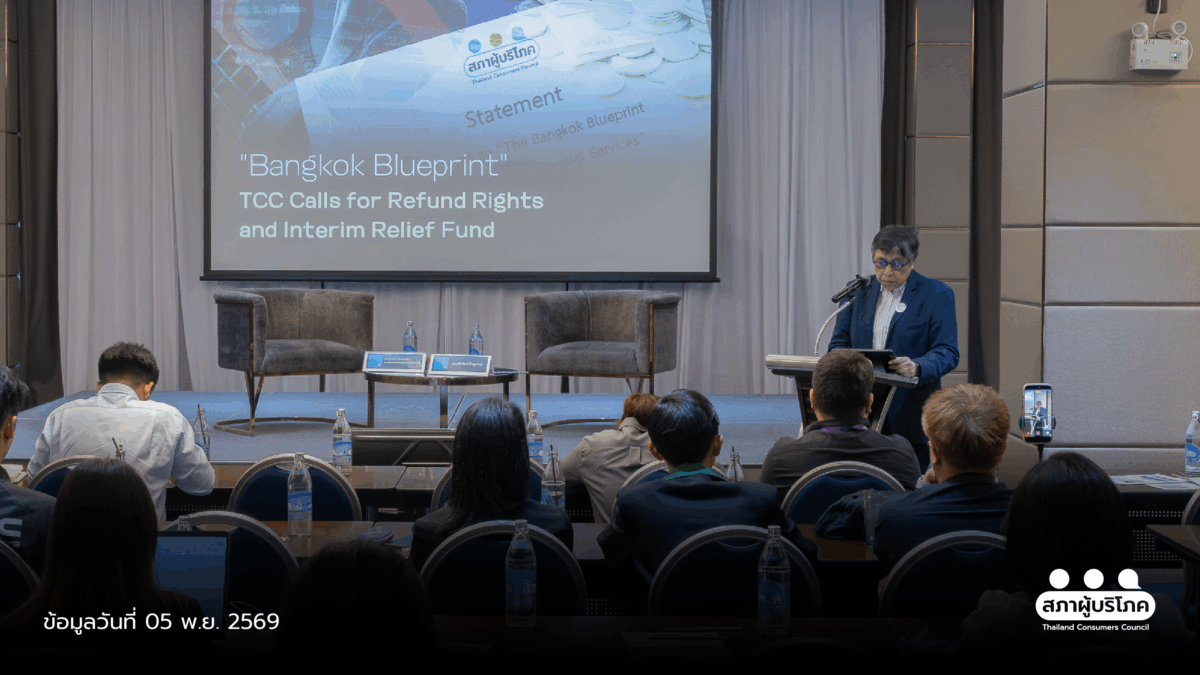
Saree Aongsomwang, Secretary-General of the Office of the Thailand Consumers Council (TCC), emphasized that digital financial fraud has become a systemic global threat requiring coordinated action from governments, digital platforms, telecommunications providers, and financial institutions.
She highlighted the scale of the problem in Thailand, where financial losses from digital scams have exceeded 100 billion baht. TCC has received approximately 11,815 scam-related complaints, with Facebook accounting for 59% of cases.
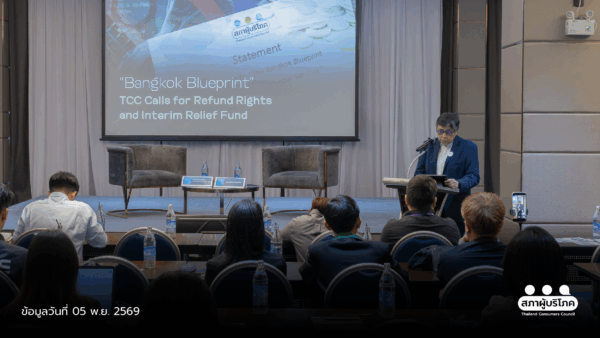
Saree also expressed TCC’s support for the Bangkok Blueprint, calling for faster consumer refunds, shared accountability, integrated complaint mechanisms, and stronger fraud prevention measures.
To address systemic failures, TCC has pursued legal action involving major technology companies, including Meta, Google, and Apple, as well as financial institutions. The cases aim not only to secure compensation for affected consumers but also to establish stronger legal accountability across the digital financial ecosystem.
“Digital financial fraud is no longer a problem confined to any single country. Sharing information and lessons learned among consumer organizations, together with cooperation involving digital platforms, financial institutions, government agencies, and other relevant stakeholders, is essential to making our collective response more effective,” Saree said.
Global Consumer Organizations Share Practical Solutions
Elia Mandari, Regulatory Engagement Lead for Digital at Consumers International, warned that artificial intelligence, digital platforms, and instant payments are making scams increasingly sophisticated. Consumers International’s 2024 Scams Barometer found that 69% of participating consumer organizations reported rising scams, while 52% identified AI as a major threat.
“Protecting consumers from scams cannot be left to consumers alone,” Mandari stressed.
She highlighted Consumers International’s Consumer Coalition to Stop Scams, which brings together 40 participants from 30 countries to promote coordinated fraud prevention, stronger safeguards, and effective consumer redress.
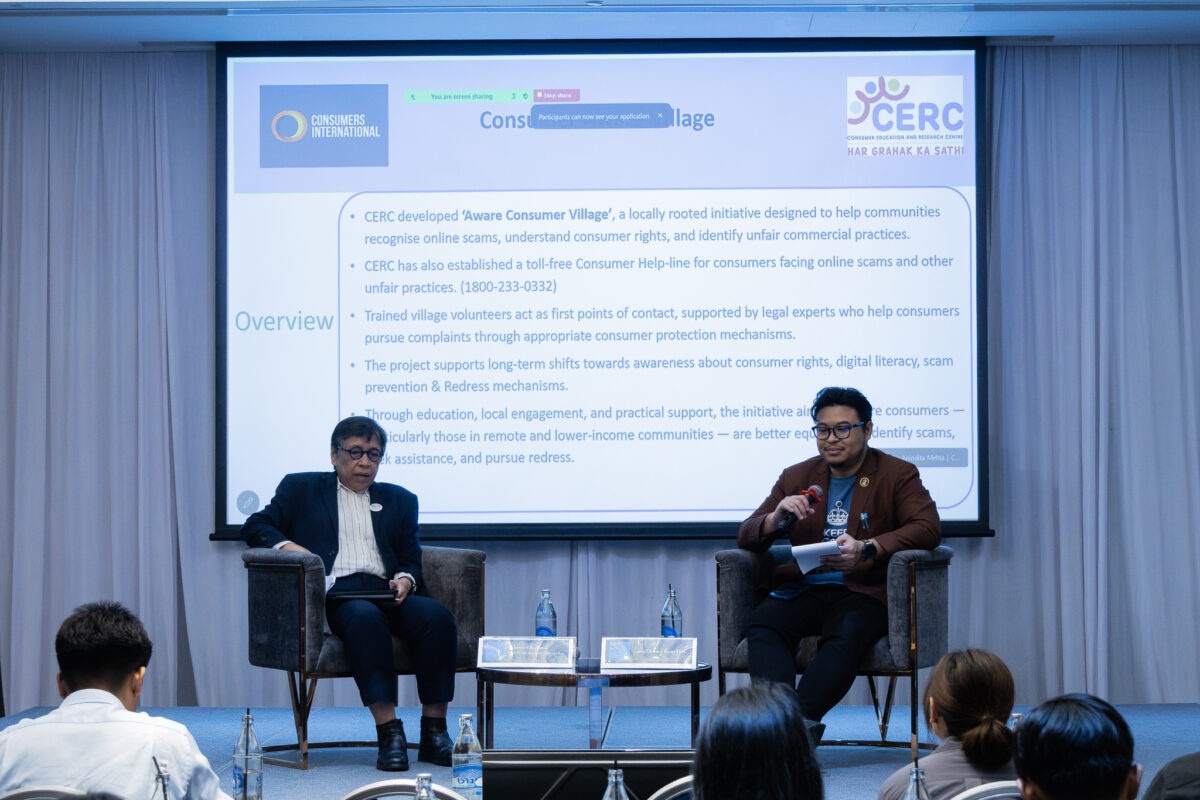
Dr. Anindita Mehta, Chief Executive Officer of the Consumer Education and Research Centre (CERC) in India, presented the “Aware Consumer Village” initiative, which strengthens digital literacy in rural communities through local-language education and trained community volunteers known as “Cyber Warriors.”
The initiative has reportedly helped reduce the sharing of personal information and one-time passwords (OTPs) by 90% among participating communities, demonstrating the importance of grassroots participation in preventing scams.
Stefano Rossetti of the European Consumer Organisation (BEUC) highlighted efforts to tackle fraudulent online advertisements under the EU’s Digital Services Act (DSA). BEUC’s investigations into suspicious financial advertisements on Meta, TikTok, and Google revealed weaknesses in content removal and reporting systems, including inconsistent enforcement and inadequate responses to complaints.
He emphasized the need for stronger platform accountability, transparent advertising systems, and effective regulatory enforcement.
Delicia Reynolds Hand, Senior Director of Digital Marketplace at Consumer Reports in the United States, introduced the “Fairness by Design” approach, which places consumer protection at the center of digital financial services.
Drawing on consumer experiences, she advocated for clearer verification signals, simplified fraud reporting, and coordinated recovery mechanisms. The goal is to reduce the burden on victims and ensure that platforms and financial institutions take greater responsibility when fraud occurs.
Fiorentina García Miramón, Director of Tec-Check in Mexico, emphasized that consumers should not have to navigate multiple institutions to resolve a single fraud case.
She proposed clearer responsibilities for digital platforms, telecommunications providers, banks, and authorities, supported by rapid information sharing and coordinated responses. She also highlighted the UK’s reimbursement framework, under which sending and receiving payment service providers generally share the costs of compensating victims of certain payment scams.
Building a Safer Digital Financial Ecosystem
The discussions highlighted four priorities for strengthening consumer protection in Thailand: greater platform accountability, safety built into digital financial services, stronger cross-sector and cross-border cooperation, and fair consumer redress.
These approaches call for advertiser verification, effective fraud detection, coordinated reporting and transaction-freezing mechanisms, and clearer responsibility for compensating victims, rather than leaving consumers to bear the burden alone.
The forum reinforced TCC’s commitment to applying international lessons to strengthen consumer protection policies and promote shared responsibility among digital platforms, financial institutions, and regulators.
Through continued international cooperation, TCC aims to advance a safer, fairer, and more trustworthy digital financial ecosystem, protecting consumers from increasingly sophisticated scams and emerging AI-related threats.