| Getting your Trinity Audio player ready... |
Thailand Consumers Council Urges Apple to Compensate Consumers Over Years-Long Wi-Fi 6E Restrictions on Mac Devices
BANGKOK, 18 November 2026 — The Thailand Consumers Council (TCC) has called on Apple to explain why certain Mac computers sold in Thailand could not access Wi-Fi 6E networks despite being advertised as supporting the technology, and to provide fair compensation to affected consumers.
Although a software update has since restored the functionality on devices tested, TCC maintains that resolving the technical problem does not address the harm consumers may have suffered during the period when they were unable to use a feature they had paid for. Some consumers reported being affected for nearly three years.
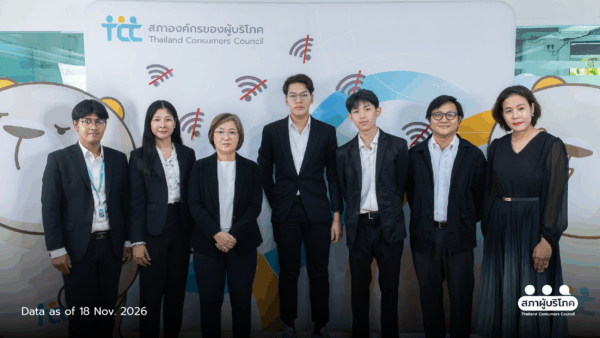
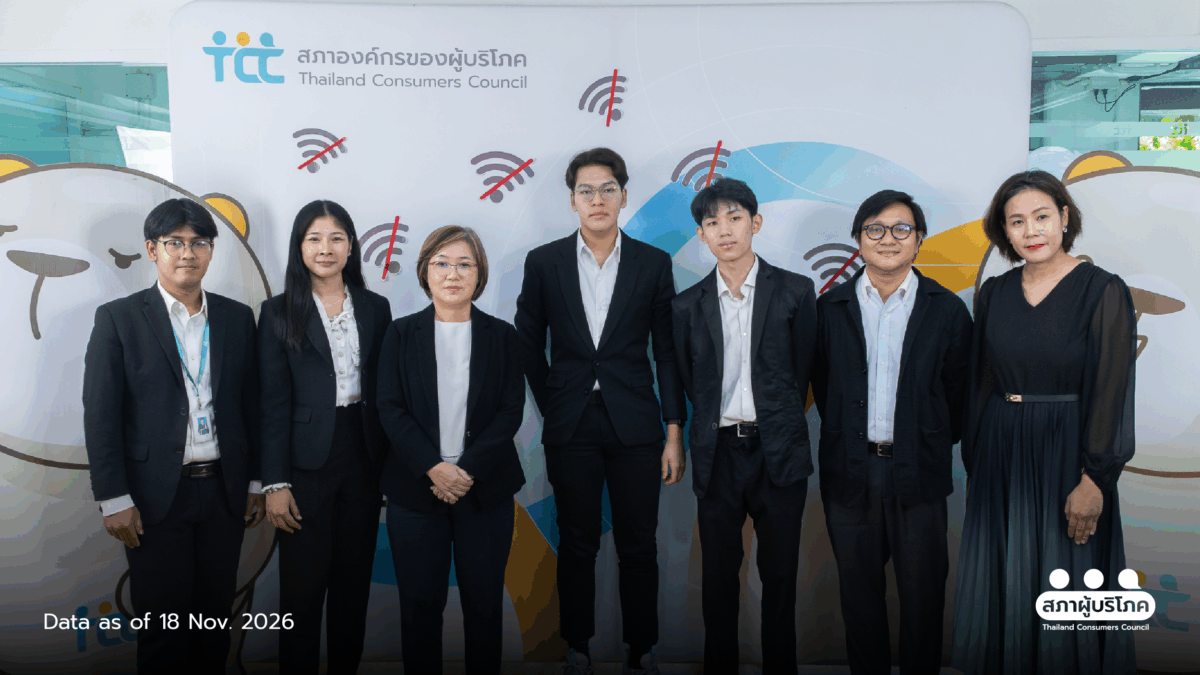
At a press conference on 18 November, TCC highlighted complaints involving Mac models introduced in 2023 that were unable to connect to Wi-Fi networks operating on the 6 GHz frequency band in Thailand.
The Council is seeking greater transparency from Apple about the restrictions, the information provided to consumers before purchase, and appropriate remedies for those affected.
Consumers Paid, But couldn’t use Wi-Fi 6E
Jiraphat Phuangchan, founder of the Apple Assist Hub community page, said the issue came to his attention after a MacBook Pro user reported being unable to detect or connect to a Wi-Fi 6E network. even though other Apple devices could connect to the same network.
The device was taken to an Apple service centre in April 2026, where several internal components were replaced. The problem nevertheless persisted.
According to Jiraphat, service centre staff explained that the restriction was normal for the particular model in Thailand. And attributed it to the National Broadcasting and Telecommunications Commission (NBTC), the country’s telecommunications regulator. The customer was advised to seek clarification directly from the regulator.
Jiraphat questioned why consumers should have to resolve a problem involving the capabilities of a product they had purchased.
He compared the situation to paying extra to use an expressway rather than an ordinary road, with the expectation of reaching a destination more quickly. Consumers purchasing Wi-Fi 6E-compatible equipment similarly expect to benefit from the faster and more stable connections associated with the technology.
“When a company becomes aware of a problem involving its own product or service, it should take responsibility for coordinating with the relevant authorities and resolving the issue,” he said. “That responsibility should not be passed on to consumers.”
Jiraphat also noted that Thailand had authorised the use of the 5.925 – 6.425 GHz frequency band for devices meeting applicable conditions since 29 April 2023. It’s raising questions about why certain products advertised as supporting Wi-Fi 6E remained unable to use the feature.
According to Apple Assist Hub’s review of product certification information, restrictions affecting the use of the 6 GHz frequency band were identified in connection with ten Mac models introduced in 2023:
- MacBook Pro 14-inch M2 Pro / M2 Max (A2779)
- MacBook Pro 16-inch M2 Pro / M2 Max (A2780)
- MacBook Pro 14-inch M3 (A2918)
- Mac Studio M2 Max / M2 Ultra (A2901)
- Mac Pro M2 Ultra, rack-mounted (A2787)
- Mac Pro M2 Ultra, tower (A2786)
- Mac mini M2 (A2686)
- Mac mini M2 Pro (A2816)
- iMac 24-inch M3, four-port (A2873)
- iMac 24-inch M3, two-port (A2874)
Apple Assist Hub reported that Apple subsequently sought to enable the relevant frequency band and released an operating system update in July 2026. The update, identified in the complaints as macOS Tahoe 26.6, reportedly restored Wi-Fi 6E functionality on affected devices.
Consumers nevertheless argue that the update does not compensate them for the extended period during which they were unable to use the advertised feature.
They are calling on Apple to explain the reasons for the restrictions and provide appropriate compensation for the loss of use.
TCC Seeks Accountability and Fair Compensation
Surakit Singhaphon, Deputy Head of TCC’s Complaints and Mediation Department, said the Council received the initial complaint on 26 April 2026 and subsequently gathered evidence and contacted Apple to investigate the issue.
Following the software update in July, devices tested were able to connect to Wi-Fi 6E networks in Thailand. However, affected consumers continued to seek clarification regarding product certification, advertising claims and compensation.
TCC referred the matter to the Consumer Protection Committee of Thailand’s House of Representatives on 1 October 2026 and contacted the Office of the Consumer Protection Board (OCPB) and the NBTC to examine the issue within their respective responsibilities.
The Council has gathered at least seven related complaints and invited Apple South Asia (Thailand) Ltd. and affected consumers to a mediation meeting scheduled for 10 November 2026.
According to TCC, Apple requested to respond in writing instead and was granted an extension until 13 November 2026 to provide the relevant information. The Council is continuing to follow up on the company’s response.
Surakit explained that a central legal question is whether the products’ advertised capabilities accurately reflected the features consumers could use in Thailand.
Section 22 of Thailand’s Consumer Protection Act B.E. 2522 (1979) prohibits advertising statements that are unfair to consumers or may mislead them about material aspects of goods or services.
If products were advertised as supporting Wi-Fi 6E without clearly disclosing restrictions on the feature’s availability in Thailand, the matter could warrant investigation under the Act.
Consumers who suffered losses because they were unable to use a product feature represented before purchase may also have grounds to seek damages under Thailand’s Civil and Commercial Code, depending on the circumstances and supporting evidence.
Compensation of 30% of the Purchase Price
Affected consumers have proposed that Apple provide compensation equivalent to 30% of the actual purchase price, supported by proof of payment, for purchasers of the ten Mac models identified in the complaints.
The proposed amount is intended to reflect the prolonged loss of access to an advertised product feature.
TCC emphasised that the 30% figure is a proposal for negotiation and consideration of appropriate redress. It is not a legally determined amount of compensation that Apple is automatically required to pay.
The Council will continue gathering evidence concerning advertising, product certification and consumer impacts to support negotiations for a fair resolution.
If an acceptable remedy cannot be reached, TCC may consider legal proceedings, including class-action litigation under applicable Thai law, to seek collective redress for affected consumers.
Consumers wishing to support the complaint process are encouraged to retain purchase receipts, device information, records of service centre visits and other evidence of the problem and any resulting losses.
Global Cases Highlight Consumer Redress
Adisak Saiprasert, Head of Policy and Innovation at the Thailand Consumers Council, highlighted international cases in which consumers organised to demand corrective action and remedies from Apple.
He noted that the company has previously addressed product-related complaints through measures ranging from free repairs and reimbursement of repair costs to financial settlements.
MacBook Pro Graphics Failures
Consumers in several countries reported graphics-related failures affecting MacBook Pro models sold between 2011 and 2013, including distorted displays, blank screens and unexpected restarts.
Nearly 40,000 people signed a Change.org petition calling for Apple to address the issue.
In February 2015, Apple introduced a free repair programme for eligible devices and offered reimbursement to consumers who had previously paid for qualifying repairs.
MacBook Pro Display Backlight Failures
Consumers also reported display backlight problems affecting certain 13-inch MacBook Pro models introduced in 2016.
The issue, commonly known as “Flexgate”, involved uneven illumination along the bottom of the display or complete backlight failure.
More than 41,000 people signed a petition calling for action.
Apple launched a free display repair programme in 2019 and subsequently extended the coverage period in 2021 to five years from the original purchase date or three years from the programme’s launch, whichever was longer.
Butterfly Keyboard in the US
Consumers who purchased certain MacBook models sold between 2015 and 2019 reported keyboard problems, including sticky keys, unresponsive keys and repeated characters.
The complaints led to class-action litigation in the United States.
Apple agreed to a US$50 million settlement, approximately THB 1.69 billion, under which eligible consumers received compensation based on the settlement terms and their repair histories.
Additional payments were made to certain eligible claimants in February 2026.
The settlement did not constitute an admission of wrongdoing by Apple.
Siri AI Ad Case Settled in the US
A separate class-action lawsuit, Landsheft v. Apple Inc., concerned allegations that Apple advertised artificial intelligence capabilities for Siri under Apple Intelligence even though certain features were not available as consumers had expected when purchasing eligible iPhone models.
Apple agreed to a proposed settlement of US$250 million, approximately THB 8.46 billion, without admitting wrongdoing.
The United States District Court for the Northern District of California granted preliminary approval on 17 July 2026 and scheduled a final approval hearing for 24 February 2027.
Eligible consumers were subsequently able to submit claims under the proposed settlement, with a claims deadline of 21 December 2026. Payments remain subject to final court approval and the applicable settlement procedures.
Adisak said these cases demonstrate that effective consumer redress can take different forms depending on the nature of the problem and the harm suffered.
While the circumstances and legal frameworks differ, the cases illustrate the importance of clear procedures for resolving consumer complaints and providing appropriate remedies.
For consumers in Thailand, he argued, the Wi-Fi 6E issue should be examined beyond the question of whether Apple has now restored the feature.
It is also necessary to consider whether consumers received accurate and sufficient information before purchase and whether they suffered losses during the period when the advertised functionality was unavailable.
Adisak stressed that collective consumer action could help bring the company to the negotiating table.
He pointed to international consumer campaigns that attracted tens of thousands of supporters and helped secure corrective measures.
He expressed confidence that collective action by affected Apple customers in Thailand could similarly encourage constructive negotiations and timely compensation.
“Promptly recognising consumer problems and providing appropriate remedies are important qualities of responsible businesses,” he said. “Apple has demonstrated this in other countries, and we expect the same standard of treatment for consumers in Thailand.”
Restoring Functionality Isn’t Enough
Associate Professor Dr. Yupadee Sirisinsuk, Deputy Secretary-General of the Office of the Thailand Consumers Council, stressed that the issue extends beyond the technical restrictions that have now reportedly been resolved.
The Council believes that the impact on consumers during the period when the feature was unavailable must also be examined.
Although the software update enabled Wi-Fi 6E connectivity on devices tested, questions remain about the information consumers received before purchase, the duration of the restrictions and any resulting losses.
Dr. Yupadee said that where investigations establish that consumers were unable to use a product feature as represented at the time of purchase, Apple should consider appropriate remedies based on the nature of the harm and the evidence available in each case.
She also emphasised that redress should extend beyond those who have already submitted complaints.
If the same issue affected multiple product models, Apple should establish a process to identify potentially affected purchasers, communicate clearly with them and provide accessible channels for submitting and assessing claims.
The responsibility of a business should not end when a product is made functional. It should also include providing accurate information, resolving problems promptly and ensuring fair redress for consumers who have suffered harm.
The case also comes as Thailand advances proposed legislation on liability for defective products, commonly known as the Lemon Law.
The proposed legislation aims to strengthen sellers’ responsibilities for defective goods and provide consumers with clearer rights to seek remedies.
According to TCC, the bill has passed its first reading in the House of Representatives and is undergoing consideration by a special parliamentary committee before returning to the House for further legislative proceedings.
Encourage Consumers to Submit Evidence
Consumers in Thailand who purchased Mac products advertised as supporting Wi-Fi 6E but previously experienced difficulties accessing the 6 GHz frequency band are encouraged to gather relevant evidence.
This may include proof of purchase, the device model and serial number, product specifications provided before purchase, records of communications with Apple service centres, and evidence of any resulting loss or inconvenience.
Affected consumers can contact the Thailand Consumers Council through: Consumer Hotline: 1502 Operating hours: Monday–Friday, 9:00 a.m.–5:00 p.m. (Thailand time) Website: www.tcc.or.th
The Thailand Consumers Council will continue seeking clarification and appropriate remedies to ensure that consumers in Thailand receive fair treatment and effective protection of their rights.